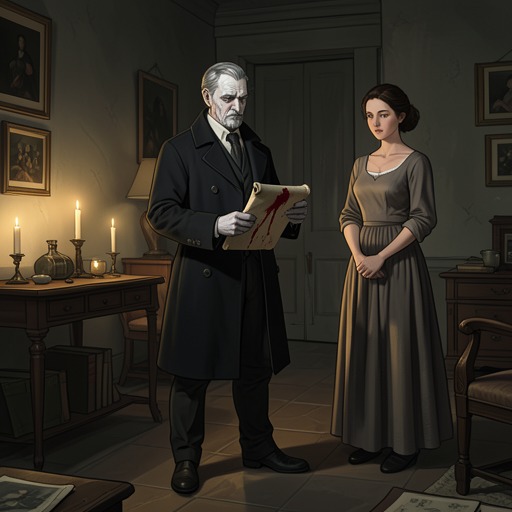
Manfred’s confession and renunciation
The Castle of OtrantoManfred’s confession and renunciation bring the succession dispute in Otranto to its resolution: after Alfonso’s vision identifies Theodore as the true heir, Manfred acknowledges the crimes behind his family’s claim, gives up the principality, and withdraws with Hippolita to a neighboring convent. His admission recasts the crisis not as a contest settled by inherited possession or force, but as the delayed consequence of a concealed usurpation.
The Contested Claim
Manfred had defended his title by claiming that Alfonso died childless and that the principality passed to Ricardo through a will. In his account to Frederic’s knights, he said that his father, Don Manuel, had received Otranto from Ricardo, who had in turn inherited it from Alfonso. Manfred also invoked Ricardo’s reputation for piety, his foundation of a church and two convents, and the family’s possession of the estate. Yet he conceded that Frederic was nearer to Alfonso by blood and proposed to submit the dispute to combat.
The challenge from Frederic’s herald made the political stakes explicit: he demanded Isabella’s return and Manfred’s surrender of Otranto, calling Manfred a usurper. Manfred had already taken Isabella into his power through her guardians and intended her marriage first to Conrad, then to himself; the proposed marriage had served his plan to unite the rival houses’ claims. When the herald offered a challenge on Frederic’s behalf, Manfred instead invited the party into the castle and promised safe conduct while he sought an amicable settlement.
The Vision and Confession
The decisive turn comes after Matilda’s death. When Manfred meets the grieving company in the castle court, a thunderclap and the collapse of the wall accompany the appearance of Alfonso’s immense form. The vision declares Theodore the true heir of Alfonso, then ascends toward heaven, where Saint Nicholas receives it. The assembled witnesses acknowledge the divine judgment; Hippolita tells Manfred that his family’s rule has ended and urges him to seek refuge in religious life.
Manfred answers by accepting responsibility for the family’s crimes and his own. He describes his confession as a public warning to future tyrants, then identifies the central fraud: Alfonso died by poison, and a fictitious will named Ricardo his heir. Ricardo, Alfonso’s chamberlain, had thus converted proximity to the ruler into a false claim of inheritance. Manfred connects this concealed crime to the supernatural judgments and to the losses of Conrad and Matilda, though he does not claim to know how Theodore’s descent makes him Alfonso’s heir.
Ricardo’s Legacy and Alfonso’s Marriage
Manfred recounts that Ricardo, caught in a storm while returning to Otranto, vowed to Saint Nicholas that he would found a church and two convents if he survived. The saint appeared in a dream and promised that Ricardo’s descendants would rule until the rightful owner became too large to inhabit the castle, provided male descendants of Ricardo remained to possess it. Manfred now recognizes the prophecy as a limit on his family’s rule: he says that no male or female member of Ricardo’s line remains except himself.
Jerome supplies the missing genealogy. Alfonso had been driven to Sicily by a storm and stayed there for three months, during which he married Victoria rather than tempt her to a forbidden relationship. He left her pregnant, intending to disclose the marriage after returning from the Crusade. Victoria bore a daughter, but, hearing the report of Alfonso’s death and Ricardo’s succession, she had no effective means to establish her claim. That daughter later married Jerome; Jerome’s account, together with Theodore’s story and Alfonso’s apparition, explains Theodore’s descent. Manfred accepts the evidence without requiring the authentic document Jerome offers, saying that the events and vision have corroborated it.
Abdication and Aftermath
The confession is followed by a concrete transfer of power. The company withdraws to the remaining part of the castle, and, in the morning, Manfred signs his abdication with Hippolita’s approval. They each take religious habits in neighboring convents, acting on the vision’s verdict rather than continuing to defend the family’s possession of Otranto.
Frederic offers Isabella to Theodore, and Hippolita supports the match because of her affection for Isabella. Theodore, still grieving Matilda, cannot initially contemplate another love. After repeated conversations with Isabella about Matilda, he accepts that he can find happiness in Isabella’s companionship while continuing to cherish his grief. The political settlement therefore follows the revelation of Theodore’s inheritance, but the ending preserves the personal cost of the succession crisis: Manfred gives up his rule after Matilda’s death, and Theodore’s new position does not erase his loss.